Coastal Birdwatching for Beginners: How to Read a Beach, Estuary and Cliff
Learn how tides, strandlines, mudflats, high-water roosts and cliff nesting seasons shape where coastal birds are — and how to watch them without causing harm.
A beach at low water can look like nothing much: a strip of sand, a line of seaweed, a few gulls. Come back six hours later and the same stretch may be crowded with waders, ducks and gulls you never saw on the first visit. Coastal birding rewards timing more than equipment, and the timing is mostly about tides, mud and seasons. Learn to read those three things and almost any stretch of coast becomes a reliable place to watch birds.
Start with the tide, not the birds
The tide decides where birds are before you have even lifted your binoculars. On a falling tide, mud and sand are exposed and feeding birds spread out across them. On a rising tide that feeding area shrinks, and everything gets pushed closer to shore. That is why the couple of hours either side of high water is often the most productive window for a beginner.
Get a tide table for the exact stretch you are visiting. Harbour authorities, local tide tables and harbour noticeboards are usually more accurate than a generic app, because they account for the shape of the estuary. Work out two things: when high water falls, and how far the water will actually come in. A spring tide can reach the dunes; a neap tide may leave a wide band of mud uncovered. Same beach, very different day.
Wind matters too. A strong onshore wind on a big tide pushes water further up the shore and can flood a roost earlier than the table suggests. If you are travelling any distance, plan to arrive an hour before high water and stay for an hour after.
Reading the strandline
Look for the dark line of seaweed, shells and debris that marks where the last tide turned. This is the strandline, and it is the beach's larder: sandhoppers, small crustaceans, flies and seeds collect along it, and so do the birds that eat them. Once you can spot a fresh strandline, you can predict where half the birds on a beach will be.
- Turnstones work through seaweed at the tideline, flicking it aside with their bills.
- Sanderling run along the wet sand ahead of breaking waves, chasing the water out and retreating before it returns.
- Rock pipits, meadow pipits and pied wagtails pick over the drier upper beach.
- Oystercatchers and curlew often feed on the wet sand just below the strandline.
Walk it slowly and diagonally rather than straight at the birds, and try to keep your shadow behind you. A bird that has seen you leave is much easier to watch than one you are following.
Estuaries and mudflats: follow the water out
Estuaries hold some of the highest concentrations of wading birds in the country, and the reason is the mud itself. Soft estuarine mud is packed with ragworms, lugworms, small shellfish and crustaceans. Different species avoid competing by probing at different depths and in different places: curlew reach deep, dunlin take small prey from the surface, oystercatchers hammer at mussels and cockles, redshank probe quickly and nervously along the channels.
Stand on the bank above the mud rather than on the mud itself, and put the sun behind you if you can, so the birds are lit rather than silhouetted. Watch the edges — the shallow water at the lip of a channel, the line where mud meets sand, the pools left behind as the tide drops. Those edges are where the food is concentrated and where birds gather.
What a falling tide gives you
- Birds appear first at the water's edge, feeding hard as the mud is exposed.
- As more mud shows, they spread out and are harder to count but easier to watch individually.
- Small groups drift towards the channels; ducks and grebes follow the moving water.
High-tide roosts: where everything gathers
When the feeding grounds flood, waders need somewhere to stand, preen and sleep. These roosts are often the same spots year after year: saltmarsh edges, shingle spits, old piers, rocky islets, the corners of fields behind a sea wall, sometimes a quiet end of a car park. A good roost can hold hundreds or thousands of birds, and it is the easiest place for a beginner to see several species at once.
It is also the easiest place to do damage. Birds at a roost are packed together, often asleep, and often already using up energy they cannot easily replace. One person walking along the shore at the wrong moment can lift the whole flock.
- Watch from a distance — a telescope from the far end of the roost beats a close approach every time.
- Stay on the path or the bank, and keep below the skyline.
- Move slowly and avoid sudden movements or bright, flapping clothing.
- Keep dogs on a lead and well away from the water's edge.
- Arrive before the tide pushes the birds up, then let them come to you.
- If the flock lifts and circles, back off and wait. They often settle again within minutes.
Many roosts sit inside nature reserves, so read the signage and respect any seasonal closures or marked viewpoints.
Cliffs: nesting seasons and how to watch them
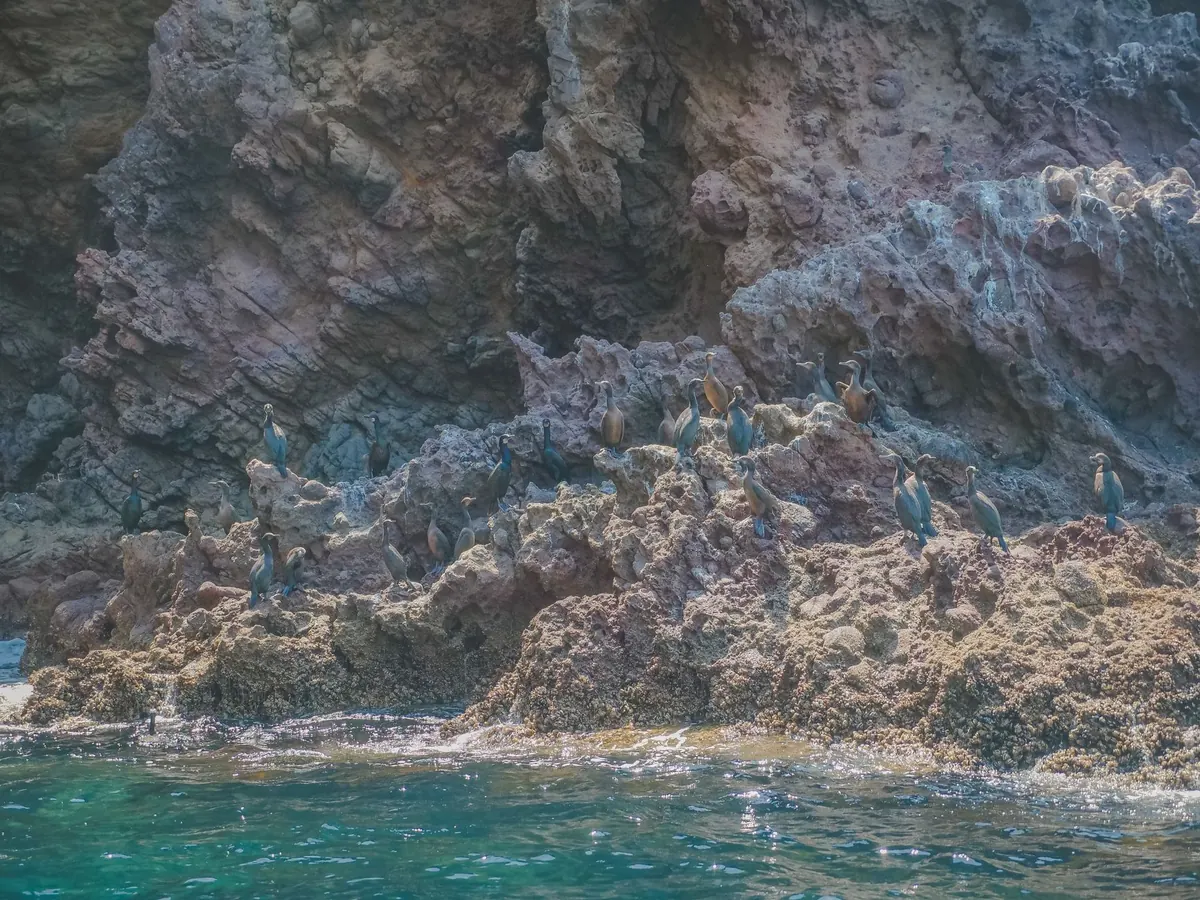
Between roughly March and July, British cliffs turn into seabird cities. The timing shifts through the season: fulmars and guillemots are early, razorbills and kittiwakes follow, puffins usually arrive in April, and shags can be found on ledges for much of the spring and summer. By late summer many birds have returned to sea, and the cliffs look strangely bare.
There are two ways to watch. From a boat or from the base of the cliff you get birds in flight and on the water, plus a sense of the noise and scale. From the clifftop you look down onto the ledges, which is better for studying plumage and behaviour. Both have their place, and a good day often involves one of each.
Safety and etiquette matter more here than anywhere else on the coast. Stay well back from the edge, especially in wind, because grass at the top of a cliff is often undercut. Do not climb down to ledges. Keep away from the airspace above a nesting colony — flushing birds off eggs and chicks costs them dearly, and eggs and young are quickly taken by gulls. If adults start alarm-calling, circling or diving at you, you are too close. Check whether drones are permitted; on many reserves they are not, and they disturb colonies badly.
Making your first coastal trip work
Put the pieces together and a coastal visit becomes a plan rather than a gamble.
- Pick your day around the tide table, aiming to be in place an hour before high water.
- Choose a spot with a mix of habitats — a beach with a strandline, an estuary mouth and a rocky headland is ideal.
- Take binoculars, warm and windproof layers, boots you do not mind getting wet, and a notebook.
- Look at the edges: the strandline, the wet sand where waves break, channel lips, the line where mud meets sand.
- Sit down and stay put. Coastal birds move towards a stationary observer far more readily than towards someone walking.
- Check local access notices, dog restrictions and reserve rules before you set off.
Expect a quiet first hour and a busy second one. That is the coast doing what it does: moving the birds about on a schedule you can learn to read.
Photo: Kindel Media / Pexels