Wading Bird Identification Made Easy: Key Species for UK Estuaries in Winter
Curlews, godwits, redshanks and dunlins crowd UK estuaries each winter. Learn how silhouette, leg colour, bill length and feeding style separate them quickly and confidently.
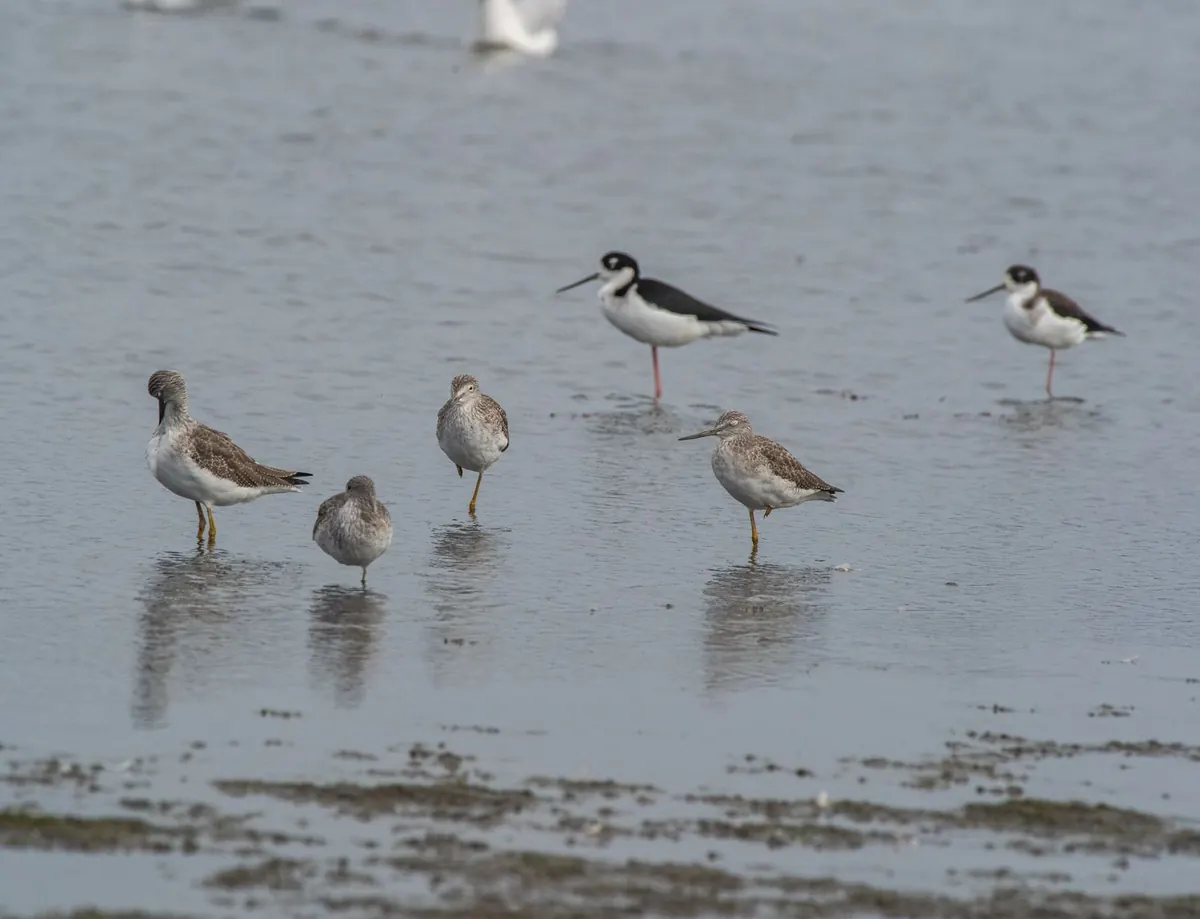
A winter estuary at low tide is one of the great spectacles of British birdwatching, and one of the most intimidating. A mile of mud and sand, a low sun, and several hundred small grey waders scattered across it. Try to identify them by plumage alone and you will spend the morning squinting at feather edges that the light refuses to show you. Try to identify them by shape, legs, bill and behaviour, and the flock starts to sort itself out.
That is the order to work in: silhouette first, bill second, legs third, behaviour throughout. Colour is the last thing you should rely on, and often the first thing that misleads you.
Begin With Size and Silhouette
Distance and dull light destroy colour long before they destroy shape. So start by asking how big the bird is and how it holds itself, using a redshank as your mental yardstick. A redshank is medium, neat, upright and slightly nervous-looking. Everything else can be measured against it.
- Much bigger, hunched, with a long curved bill: curlew. It often looks as though it is carrying a heavy load.
- Tall and upright with a long straight bill: godwit. The bird looks stretched, all legs and bill.
- About redshank-sized but stockier and shorter-billed: knot.
- Half a redshank, dumpy, gathering in tight swirling flocks: dunlin.
- Short-billed, big-eyed, running in bursts and then freezing: a plover, most likely grey plover on the open mud.
Learn that ladder of sizes and you have already removed half the confusion. Most identification mistakes on estuaries come from trying to name a bird before you have decided how big it is.
The Bill Tells You More Than the Book Does
Bill length and shape are the most reliable features on a wader, and the easiest to judge in poor light, since you only need the outline rather than the detail.
Curlew carries the longest bill on the estuary, deeply curved, and usually longer than its own head. When feeding, the whole bill vanishes into the mud and the bird's head stays down for seconds at a time. Whimbrel is very similar but noticeably shorter-billed and more distinctly striped about the head; a handful winter here, but in the depths of December it is usually safest to assume curlew unless the bird is close and the bill looks stubby.
The two godwits are separated by the same logic. Bar-tailed godwit has a long bill that turns gently upwards, often with a pinkish base, and its legs are relatively short. Black-tailed godwit has a bill that is dead straight and a bird that stands visibly taller, with more leg showing. If you can see the bill against the sky, the upturn or lack of it settles the matter quickly.
Among the smaller birds, dunlin has a medium bill with a slight droop at the tip, knot a short, almost stubby one, and sanderling a short, fine, straight bill on a bird that never seems to stop running. Redshank is medium and fine; spotted redshank is longer, finer and belongs to a leggier bird that often wades deeper than its relatives.
Legs, Water Depth and Where a Bird Stands
Leg colour is excellent when you can see it, and useless when you cannot. Backlighting, mud and distance all conspire against you, so treat legs as confirmation rather than as your first clue.
- Orange-red: redshank, turnstone
- Black or dark grey: dunlin, sanderling, grey plover, bar-tailed godwit, spotted redshank
- Greenish or olive-grey: knot, and black-tailed godwit in winter
- Blue-grey: curlew
- Pink: oystercatcher
Leg length is often more useful than leg colour. Watch how deep the bird is standing. A godwit feeding belly-deep in water where a dunlin is only ankle-deep is telling you something about itself without any colour at all.
Watch What the Bird Is Doing
Behaviour is the most underused identification tool on an estuary, and it is free. Feeding action, pace and flocking habit are often visible when nothing else is.
Curlew moves slowly and deliberately, probing deep, often spread out and solitary. Bar-tailed godwits feed with a rapid, mechanical stitching motion, frequently in loose lines along the wet sand at the tide edge. Black-tailed godwits are busier and more restless, pecking and stitching on softer mud, often in tighter groups. Redshank dash about, bob their heads and are usually the first to call an alarm. Dunlin feed like sewing machines in tight, coordinated flocks. Knot pack into dense grey carpets, often roosting or feeding far out on the flats. Sanderling sprint along the surf line, chasing the retreating wave and then running back from the next one. Grey plover run a few paces, stop dead, then pluck. Turnstone is the one flipping weed and stones on the strandline.
Four Confusion Pairs Worth Learning Properly
Bar-tailed vs black-tailed godwit
Bill upturned and shorter-legged against bill straight and longer-legged. Bar-tailed usually feeds on sandier ground nearer the surf; black-tailed prefers softer mud and is the more likely bird on an inland flood or wet meadow in winter.
Dunlin, knot and sanderling
Dunlin is the medium-billed, black-legged one in tight flocks. Knot is stockier with a short bill and greenish legs. Sanderling is the pale, restless runner on the open sand, usually in small loose parties rather than a dense flock.
Redshank vs spotted redshank
Redshank has orange-red legs and is noisy and excitable. Spotted redshank has dark legs, a longer, finer bill and a habit of feeding in deeper water with a steady, deliberate stitching action, often alone. In winter it is pale grey above with a strong white supercilium.
Grey plover vs golden plover
Grey plover feeds on open mud with a stop-start run and shows black "armpits" in flight. Golden plover is more often on fields and grassland, and its flight call is a clear, mournful whistle.
Fieldcraft That Makes Identification Easier
Time your visit around the tide. A rising tide pushes birds closer to the shore, and the last two hours before high water are usually the best of the day. Put the sun behind you if you can, and accept that a grey afternoon will test you more than a bright one.
Use binoculars to watch behaviour and a scope on a tripod for bill detail. Learn a few calls: curlew's rising "cur-lee", redshank's ringing three-note alarm, the chattering of godwits and the thin, drawn-out note of dunlin. Visit the same estuary regularly and find the high-tide roost, because a roosting flock lets you study shapes and legs at leisure rather than snatching looks at feeding birds.
Keep a notebook, even a rough one. Writing down what you actually saw — bill length relative to head, leg colour, feeding action — sharpens your eye far faster than flicking through a guide on the seawall. Local bird recorders and surveys such as the Wetland Bird Survey welcome extra pairs of eyes, and counting waders is a good way to learn them.
A Simple Routine for Every Bird
- Judge the size against a redshank.
- Silhouette the bill: length, curve, upturn or droop.
- Check the legs, if the mud allows.
- Watch it feed for at least thirty seconds.
- Name it only when all four agree.
Do that a few times on a single visit and you will find the flock dividing itself into recognisable characters: the hunched, solemn curlew; the busy redshank; the tight, whirring dunlin cloud; the neat, upright godwit. Winter estuaries reward patience. Give the birds a minute of your attention and they will usually tell you exactly what they are.
Photo: Robert So / Pexels